A “City of Solutions”: On the Huntington State of the City Address and the Proposed Budget for 2021

Crime is declining, revenue is sustainable, and the state of the city is stable, according to Huntington mayor Steve Williams during the State of the City Address February 14.

“We have positioned the city to be fiscally and operationally sound,” the mayor said.

During the address, the mayor described the city as a “city of solutions”, alluding to the idea that the people of Huntington look for “the solutions rather than the excuses”, and praised the resiliency of the citizens of Huntington.

“A city of solutions is defined by the fortitude of the people who comprise the community,” The mayor said. “The corporate governing structure of the city is simply a reflection of its population. Huntington has a highly-chronicled history of resilience.”

The mayor also extolled the improvements that have been made to the city in recent years.

“Jobs and investment are returning,” The mayor said. “Crime is declining. Roads, sidewalks and sewers are all being repaired at levels that were unthinkable in years past… In short, Huntington is engaged in a transformational renaissance.”

The mayor announced several scheduled improvements and projects for the city, including $5 million in storm sewer improvements, $2.4 million in street improvements, and the construction of a Marshall University baseball stadium.

According to the mayor, the police and fire departments have “the largest budgets in the history of each of their respective departments.” The mayor spoke about the various improvements to the police and fire departments in recent years, such as new police cruisers and the complete renovation of the Guyandotte Fire Station. The mayor also proposed further improvements to the police and fire departments: five more police cruisers, another front-line fire apparatus, and 50 more sets of turnout gear for firefighters.

The mayor also provided a proposed budget for the fiscal year 2021 for members of City Council to review, as well as the citizens of Huntington.

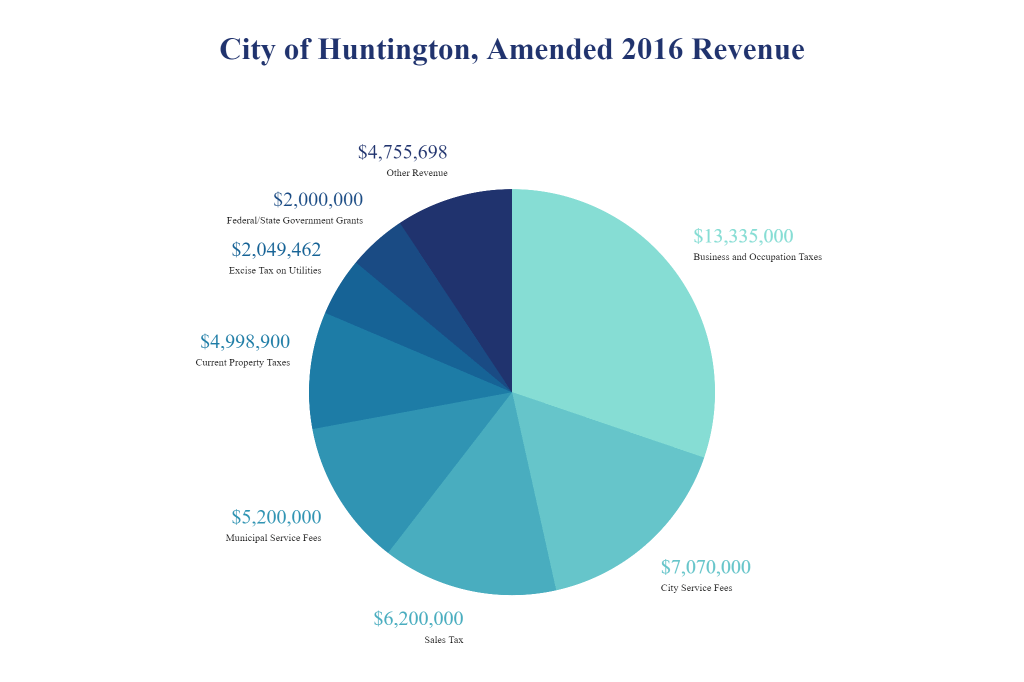
Available below is a breakdown of major sources of revenue from Huntington’s 2016 budget. The section labeled “Other Revenue” includes various specific taxes and fees, such as building permit fees and franchise fees – all sources listed in “Other” individually total less than $1 million. The total revenue for 2016 for the City of Huntington was $47,033,160. All final numbers in the following charts are derived from the official budget releases from the City of Huntington.
A screenshot of a cell phone

Description automatically generated

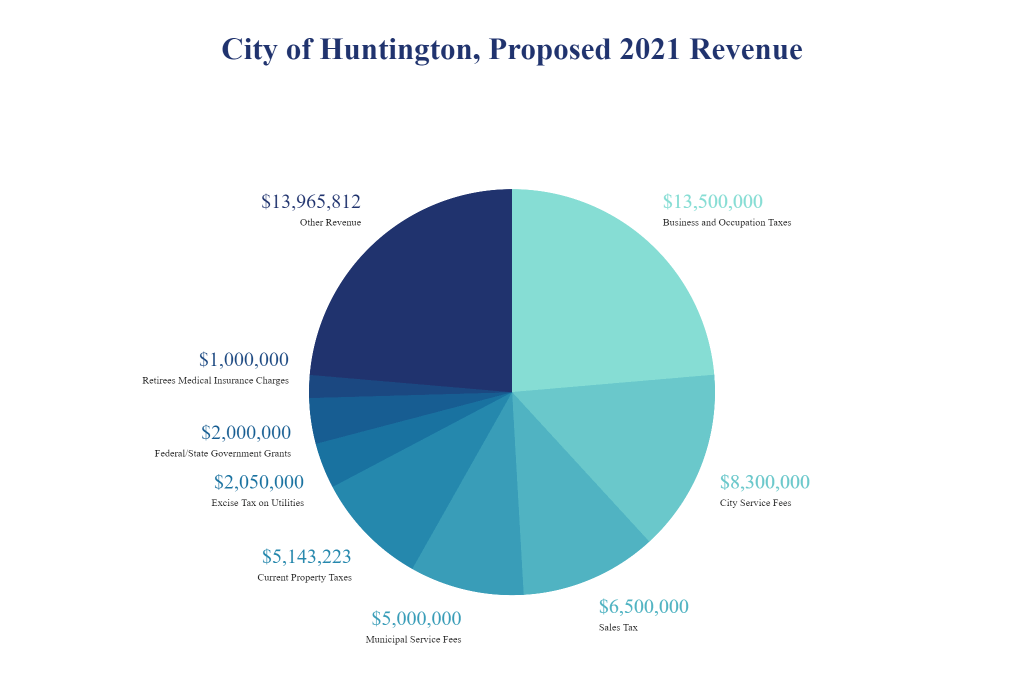
And here is a breakdown of the proposed budget for the fiscal year 2021. The total revenue proposed for the fiscal year 2021 is $58,315,812 – an increase of almost 24 percent from 2016.
A screenshot of a cell phone

Description automatically generated

Business and occupation (henceforth B & O) taxes have remained close to the same in the raw amount of revenue that it provides the city, but it has decreased its overall contribution percentage to the budget. The same is true for sales taxes – a marginal increase in actual revenue, but an overall decrease in the percentage of contribution. However, retirees’ medical insurance charges have increased enough to breach the seven-figure margin.

Also, while federal/state grants may appear the same on these charts, it’s important to note that federal grants increased to 1.8 million, whereas state grants decreased to .2 million in the proposed budget for 2021.

Part of the reason that the budget has increased is an increase in sources of revenue – while there were 33 sources of revenue in 2016 that each contributed less than $1 million, there are 37 listed in the proposed 2021 budget. However, four extra sources of revenue don’t account for an increase of over $9 million. The major cause of the increase in miscellaneous revenue is that there are unassigned funds listed in the proposed 2021 budget that total almost $5 million – finances leftover from the 2020 budget. No such lists exist in the 2016 budget.

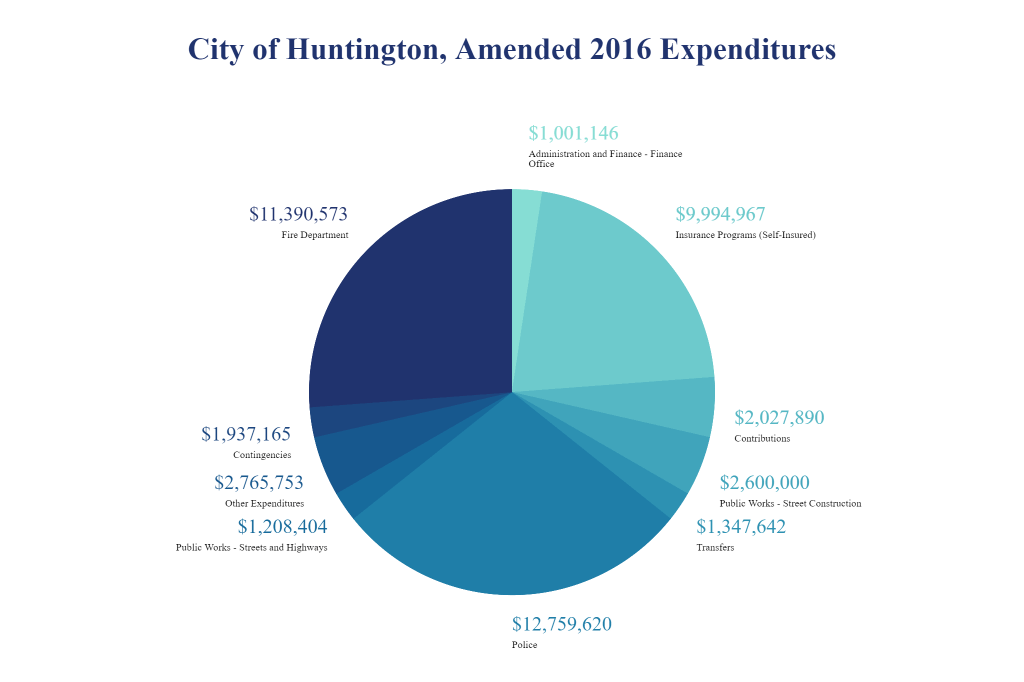
Now, let’s look at the expenditure summary from 2016. The section labeled “Other Expenditures” contains all expenditures that individually total under $1 million. Again, all final numbers in the following charts are derived from the official budget releases from the City of Huntington. The total expenditures in 2016 equaled the 2016 amended budget of $47,033,160.
And here is a breakdown of the proposed expenditures for the fiscal year 2021. Again, the proposed expenditures equal the proposed revenue total of $58,315,812.
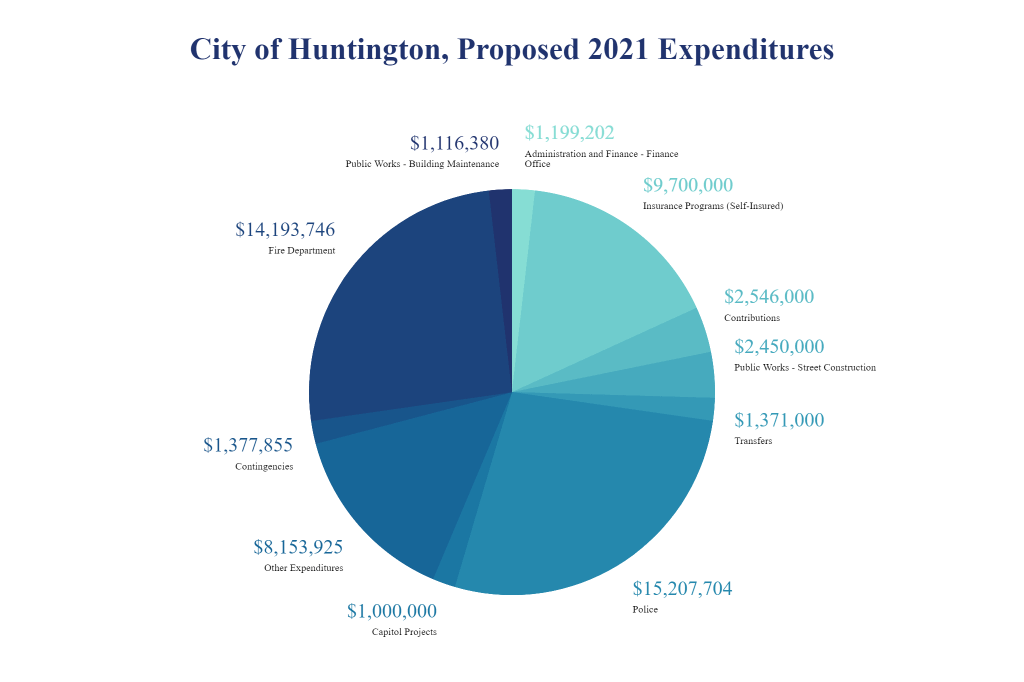
Like the revenue graphs listed earlier, the “Other Expenditures” list has grown significantly since 2016. This is mostly due to many sources having increased expenditures listed in the budget. In the proposed budget for 2021, 16 of the 27 expenditures listed have increased expenditures from the 2020 budget.

The shifting nature of city expenditures explains why “Building Maintenance” has shifted above $1 million, and why “Streets and Highways” has shifted below the same margin.

However, in both 2016 and the proposed budget for 2021, the three largest expenditures by a wide margin are police, fire, and insurance. These three variables represented 73.6 percent of expenditures in 2016, and 67.1 percent of expenditures in the proposed budget for 2021.

While the budgets and expenditures have increased in recent years, the two totals still equalize each other, ensuring that Huntington does not incur an issue with debt.

United Way of the River Cities: A Critical Fundraiser for Local Agencies

With dozens of social service agencies in Cabell County and other counties near it, questions of how to raise money are common – and United Way of the River Cities is a nonprofit that has been helping fund these agencies for nearly a century.

“The challenge is telling compelling stories that align with your passion,” said Bill Rosenberger, the Director of Resource Development for UWRC. “There are emerging needs that we want to take care of.

Founded in 1922 by local citizens to improve human service concerns, UWRC helps fund over 30 social service agencies in four counties of West Virginia and one county in Ohio. One of Rosenberger’s main duties is securing those funds.

“I raise the money – or at least, I attempt to,” Rosenberger said. According to Rosenberger, while funds are raised in all five counties that the UWRC works in, the majority of money comes from Cabell County, West Virginia.

Rosenberger is a fundraiser, but that doesn’t mean that he has administrative power over the allocation of those funds – that power goes to an independent council within United Way of the River Cities.

“I ask for money, but I don’t decide where it goes,” Rosenberger said.

The funds raised by UWRC go toward a variety of social service agencies in the five counties that it works in. One of the primary recipients is the Huntington City Mission, which the UWRC provides about 25,000 dollars a month in funds for. Another agency that receives funding is Harvest for the Hungry, a food bank in Ironton, Ohio. According to Rosenberger, the UWRC recently gave 5,000 dollars to Harvest for the Hungry to help pay their electric bill.

“That’s going to keep their pantry open,” Rosenberger said.

Another initiative that UWRC helps fund is Super Saturday, an annual event that UWRC hosts to help families with childcare advice and literacy. Though Super Saturday primarily focuses on children, UWRC also helps with adult literacy training for those who need it. However, the UWRC does not directly act during Super Saturday – rather, local agencies in Huntington help organize and perform the event.

“We just organize the event and let [people] come in,” Rosenberger said.  “Typically, a lot of young families come in.”

United Way of the River Cities also helps with tax preparation and provides it for free for individuals or families who can’t normally afford it because of the steep prices that other tax filers tend to ask. According to Rosenberger, in the spring and summer months, UWRC is less focused on funding social service agencies and more focused on running these types of programs and updating donors.

The UWRC also partially determines where their funds will go through their Community Needs Assessment, which determines what the UWRC believes to be the most pressing issues in local communities. According to Rosenberger, the most pressing issue used to be obesity – however, in recent years the most pressing issue was substance abuse and recovery. Rosenberger believes the opioid epidemic and its fallout are the most pressing issue to all of the counties that the UWRC is active in.

As for the people that UWRC helps, Rosenberger admits that it’s a bit different than what he’s used to.

“My ability to see the bigger picture can be compromised because of my socioeconomic stature,” Rosenberger said.

United Way of the River Cities continues to function, even during the ongoing COVID-19 pandemic. The primary function UWRC is currently serving is supporting 211, a free helpline that connects people to local health and human services resources in their local communities. The UWRC is also serving to inform local communities on updates regarding COVID-19 and is providing a list of various resources for people in their active areas to take advantage of.

The Marshall University Foundation: Scholarships and Donations at Marshall

Marshall University’s campus may be empty right now, but that doesn’t stop the people working for the Marshall University Foundation from trying to do their job the best they can.

“Everything costs money, so we’re pulled in pretty close”, said Joe Allwood, the Chief Operating Officer of the Foundation. As the primary fundraising organization for the university, the Foundation was founded as a nonprofit in 1947 to organize and disperse private resources for the university.

And this goal is being achieved with greater success every year. According to Allwood, the Foundation brought in 5.3 million dollars in 2009, and 50.3 million dollars in 2019.

“Our team worked very hard for a decade for that one zero,” Allwood said. Allwood also said the number of donors has increased “exponentially” in the same time frame.

“Everything we do is donor-centric,” Allwood said.

In mid-2019, the Foundation started their most ambitious project yet: “Marshall Rises”, a campaign dedicated to making Marshall and those affiliated with it greater than the sum of their parts. According to Allwood, it’s the most ambitious campaign the Foundation had ever undertaken.

With a goal of 150 million dollars, the campaign is indeed reaching for lofty heights. But when the campaign was publicly announced in October at Marshall’s Homecoming, the Marshall Rises campaign had already amassed over 105 million dollars, according to Allwood. Currently, the campaign has raised over 110 million officially.

“It’s moving much more aggressively than we expected,” Allwood said.

The money contributed toward the campaign is primarily from private donations. According to Griffin Talbott, the Chief Director of the Annual Fund for the Foundation, the organization does not receive any money from Marshall students’ tuition, so the Foundation depends on these donations to keep their programs running.

And while some of these donations are quite generous, one doesn’t have to break the bank to make a difference.

  “A lot of people don’t think they can make an impact with their small gifts,” Talbott said.  “But state funds decrease, and the university’s needs increase.”

However, this doesn’t change the fact that many of the Foundation’s donors choose to donate large amounts. According to Allwood, 5-7 percent of donors contribute 95 percent of funds in the average campaign. And sometimes, they would come from unexpected sources.

“What shocked me was that elderly couples sometimes would lose a spouse, and we would be one of the first people they called,” Allwood said.

But where does the money donated go?

Much of the time, donations come with specific funds or causes that the donor wants to contribute toward, and the Foundation does its best in honoring those requests. The donors can typically donate toward any fund or cause they wish, if it’s not a specific student.

The Marshall Rises campaign also has three major funds that it works toward, according to President Gilbert: a new building for the Lewis College of Business, a new baseball stadium, and scholarships.

“Rising tuition costs and student debt are something that every student faces, and will continue to face,” Talbott said.

The Foundation awarded over 2100 scholarships in the 2018-2019 school year to Marshall University students. According to Allwood, there are close to 1,000 funds that the Foundation runs – many, but not all, are scholarships.

And many of these scholarships are funded by alumni, to give people who otherwise might not have been able to come to Marshall a chance.

“The people in the Marshall family are our most valued resource,” said Matt Hayes, the Chief Director of Alumni Relations for the Foundation.

However, one of the biggest challenges that the Foundation faces is keeping close contact with both students and alumni. According to Allwood, many years there’s money left in funds and scholarships because either students did not apply, or they were simply unaware of their existence. Also, due to the chaotic nature of post-college life, it’s hard to keep up with fresh alumni, according to Hayes.

“Our biggest challenge is maintaining a connection with [alumni],” Hayes said. According to Hayes, while there are over 109,000 alumni listed in the Foundation’s database, only about 32,000 (or around 29 percent) have registered contact information.

And according to Hayes, the testimony from alumni is key to the Foundation.

“There is nothing more powerful for a donor to see or hear than [a gift recipient] saying thank you,” Hayes said. “You can’t put a price tag on a ‘thank you’.”

And as for keeping up scholarships and funds for students, Hayes believes that it’s something he’ll work toward improving for the rest of his life.

“We are here for you,” Hayes said. “And we are here for those who come after you. As long as we have life on this planet, we want to ensure that there is a Marshall University to serve. Your relationship with Marshall University is for a lifetime.”

The Surgeon General is Coming to Huntington

Marshall University will partner with Vice Admiral Jerome A. Adams, U.S. Surgeon General, for an event presented by the Carter G. Woodson Lyceum February 13.

             The event is part of ongoing events that the Lyceum is presenting for 2020 Black History Month. The theme of 2020 Black History Month is “African Americans and the Vote”, in reference to the 15th and 19th amendments to the Constitution.

            Adams is a board-certified anesthesiologist, and graduated with a medical degree from the Indiana University School of Medicine. He has served as the U.S. Surgeon General since September 2017. He also served as the Health Commissioner of Indiana from 2014 to 2017, during which time he helped combat a severe outbreak of the HIV virus caused by the sharing of needles. As the Surgeon General, Adams’ motto is “better health through better partnerships”.

            Adams has previously visited Huntington in May 2018 for Cabell-Huntington Hospital’s Regional Health Summit, speaking primarily about the opioid epidemic.

            “I came to Huntington because it’s one of the best stories in the United States in terms of recovery,” Adams said. “If we can turn around overdose numbers here, we can do it anywhere.”

            The event will take place in the Joan C. Edwards Performing Arts Center, at 4 PM February 13. Adams will be speaking about his perspective on black history, as well as share his experiences and priorities as the “Nation’s Doctor”.

The 2020 State of the Union Address

During the annual State of the Union Address today, President Donald J. Trump focused primarily on commerce, public health, and foreign affairs – in opposition to many of my predictions – and spoke often about major advances in the U.S. over the three years of his administration.

“Everyone wants to be where the action is,” said Trump. “And the United States is indeed where the action is.”

Trump spoke at length about the rapidly growing economy of the country during the early moments of the Address. He brought attention to the specific numbers of people who came off welfare and food stamps in recent years, as well as calling attention to America now being both energy independent and the number one producer of oil and natural gas in the world. He also brought up the recent trade deal with Canada and Mexico, mentioning that “Unfair trade is perhaps the biggest reason I decided to run for President”. I predicted that Trump would speak about growing commerce without mentioning any downsides, and that prediction was completely correct.

            One of the things that I didn’t predict Trump discussing, however, was public health, of which various issues were spoken. Trump spoke for a long time about the status of U.S. healthcare, saying that “Our new plans are up to 60 percent less expensive, and better.” Trump also defended his executive order of price transparency in U.S. healthcare, saying that no one should be “blindsided by medical bills”.

            More pressing to Huntington, Trump also spoke about the administration’s ongoing efforts to combat the opioid epidemic, as well as lowering the price of prescription drugs – the latter of which Trump was very passionate about.

            “Get a bill on my desk, and I’ll sign it immediately,” Trump said.

            In opposition to my prediction, Trump also briefly mentioned that the U.S. was working with China to prevent the spread of Coronavirus, as well as making a bold statement that the U.S. government “will eradicate the AIDS epidemic in America by the end of this decade”.

            Trump later spoke about the state of education in this country, and asked Congress for support in passing several bills to improve American public education. He also spoke about an upcoming plan to offer vocational and technical education in every high school in America.

            A major running thread throughout the Address was various foreign affairs and dealing with illegal immigrants. Trump talked at length about California’s passing of sanctuary laws, which he viewed as abysmal ideas with “catastrophic results” He then mentioned a bill that was currently in Congress that he wanted to be passed immediately, which would allow American citizens to sue sanctuary cities or states if they or a loved one were harmed or killed. Trump also spoke about the U.S. supporting the citizens of Venezuela as well and argued against the current Venezuelan government.

            Trump also brought up the assassination of Qassem Soleimani, which he viewed as “a flawless precision strike that killed Soleimani and ended his evil reign of terror forever”. He also condemned terrorism of any kind, saying that “If you attack American citizens, you forfeit your life”.

            Many of my predictions were incorrect, but many were correct as well. I was right about an emphasis on commerce, trade, and foreign affairs, and wrong about the lack of a mention of Coronavirus. I also failed to predict either way whether Trump would talk about illegal immigration or healthcare. Either way, the 2020 State of the Union Address was dramatic and celebratory, with Trump bringing up examples of people affected by his administration throughout the Address, and ended on a rather heroic note.

“America is a land of heroes,” Trump said.

The Upcoming Carter G. Woodson Annual Lecture

The annual Carter G. Woodson Lecture will take place February 6, with the chair of Harvard University’s Department of History as the guest lecturer.  

            The lecture will be delivered by the Carter G. Woodson Lyceum, a Marshall University organization dedicated to black history and addressing current issues. The theme of the lecture is “African Americans and the Vote”.

            The theme of “African Americans and the Vote” is carried throughout the 2020 Black History Month. It refers to the 15th and 19th amendments, as well as the struggles that African Americans had even after the amendments were ratified, according to the Woodson Lyceum’s website.

            Evelyn Higginbotham, the chair of Harvard University’s Department of History, is the guest speaker. Her most notable award was received in 2014: the National Humanities Medal, which was presented to her by former president Barack Obama in 2015, for “illuminating the African American journey”. Higginbotham is also the president of the Association for the Study of African American Life and History – an association that Carter G. Woodson himself created.

            The lecture will begin at 4 P.M. February 6, in the Shawkey Room of the Marshall University Student Center. Vice Admiral Dr. Jerome M. Adams, US Surgeon General, will be lecturing at the Joan C. Edwards Performing Arts Center at 4 P.M. February 13.

What will be said at the State of the Union Address?

President Donald J. Trump will likely highlight the growing economy of the country and recent trade deals, as well as comment on the situation with Iran and the results of his potentially ongoing trial with the Senate in the State of the Union Address February 4.

The primary focus of the address will likely be economic growth or decline, unemployment, the creation of new jobs, etc. Based on his recent Twitter posts about how the economy is doing well these statistics will likely be presented as fact, with the President mostly highlighting those that are currently doing well (for example, low unemployment rates and the stock market’s growth). However, these facts are also probably going to be presented without certain contextual facts – for example, mentioning the number of jobs created this year, and not that the number of jobs created was actually lower than in previous years.

Another matter that may come up during the State of the Union Address is the recent approval of the United States – Mexico – Canada Agreement (USMCA) by the Senate Finance Committee, which is currently passing through Congress. Since the trade agreement is mostly bipartisan, there’s a high likelihood that it will process through Congress successfully. The President will probably bring particular attention to this fact, using it as a springboard to assert his successes over the past year, and his years as the President. Since this is an election year, the President is almost certainly going to take the time to assert his successes, and not his weaknesses, due to the fact that the State of the Union will likely be brought up during his 2020 campaign.

The current situation with Iran will almost certainly be on the table. Tensions have been rising between the United States and Iran for months, and with the recent death of one of Iran’s most notable military commanders, war between the two countries may be inevitable. However, don’t count on the President announcing a declaration of war at the State of the Union Address. He will likely comment on the state of affairs with Iran, including his own opinion on the killing of General Soleimani, and justify why the United States may need to go to war, but won’t actually make a declaration.

There’s also the matter of the global climate issue, as well as the recent public concern over the coronavirus. Between the Australian bushfires and global climate awareness, there is more media attention on climate change than ever before, and the coronavirus has many people concerned over their public health, since multiple people have been diagnosed with it in the country. However, I don’t think the President is going to mention these issues during the Address. Between his cavalier ‘fake news’ attitude, the fact that he has already pulled the United States out of the Paris Agreement, and that he already mentioned that the United States apparently has the coronavirus under control in a CNBC interview, the President likely does not believe in the validity of climate change as a real issue.

The trial is likely going to be one of the major facets of the Address. Personally, I don’t think the trial will have ended by the time the State of the Union is given. I think the President will comment on the ongoing trial, and use the State of the Union as a platform to assert his own innocence over the charges of criminal bribery and wire fraud. I also think the President is going to use the opportunity to comment (most likely negatively) on other members of the United States government – especially people such as Nancy Pelosi, who he is documented to not get along well with.

I think the 2020 State of the Union Address is going to be a controversial subject, especially considering the trial process likely won’t be over by the time the Address is given. This is only the second in history to take place during an active trial, the first being President Clinton’s State of the Union Address in 1999. I think that there will be a noticeable emotional stint to it – the President will likely address the Democratic Party with contempt, as well as Nancy Pelosi, because of the active trial. The President is already a controversial figure, and with the recent events of the past two months, it would not shock me if the State of the Union Address becomes a catalyst for even more political turmoil.

Design a site like this with WordPress.com
Get started